
Choosing a cooling method for fresh produce is not just a procurement decision. It is a decision about how thoroughly and consistently heat moves out of your product, how well that cooling holds during packing and transport, and whether every piece in every bin reaches and maintains the target temperature. The method you choose determines the physical interaction between ice and produce at every stage of the cold chain.
At Deepchill®, we work with produce operations across more than 40 countries. What we consistently observe is that cooling uniformity, surface contact, and field heat removal separate adequate performance from genuinely reliable produce protection.
Understanding the Three Produce Cooling Methods
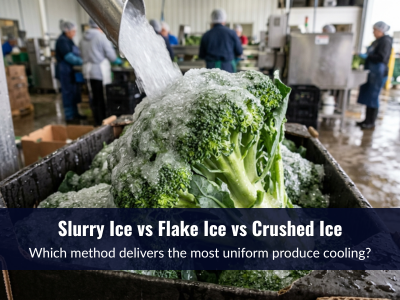
- Slurry Ice: A pumpable mixture of fine ice crystals suspended in chilled water. Its fluid consistency allows it to flow around produce, conform to irregular shapes, and fill the spaces between tightly packed items.
- Flake Ice: Thin chips scraped from a refrigerated drum surface. Settles around produce reasonably well and provides good surface contact when applied and packed carefully. Performance depends on how evenly it is distributed.
- Crushed Ice: Block or cube ice broken into irregular fragments. Cannot conform closely to produce surfaces or penetrate gaps between tightly packed items. Widely used but physically the least precise of the three methods.
Cooling Performance Comparison
| Criteria | Slurry Ice | Flake Ice | Crushed Ice |
|---|---|---|---|
| Surface contact | Total, uniform wrap | Good, position-dependent | Partial, irregular |
| Field heat removal | Very fast | Fast | Moderate |
| Cooling uniformity in bin | Excellent | Good | Variable |
| Hot spot risk | Very low | Low to moderate | Higher |
| Coverage in packed cartons | Complete | Partial | Limited |
| Temperature consistency in transit | Excellent | Good | Degrades with movement |
| Irregular shaped produce | Excellent | Good | Poor |
| Penetration into tightly packed loads | Full | Surface-weighted | Surface only |
| Broccoli and dense vegetables | Excellent | Good | Acceptable |
| Delicate produce (berries, leafy greens) | High, no pressure damage | Moderate | Risk of bruising |
How Each Method Physically Interacts with Produce?
The core difference: slurry ice behaves like a liquid, flake ice like a granular solid, crushed ice like a coarse aggregate. That distinction determines how heat actually moves out of your product.
Contact area and heat transfer:
- Slurry ice conforms completely to the produce surface, including florets, stems, and irregular faces
- Flake ice makes contact at pressure points and flat faces, leaving air gaps elsewhere
- Crushed ice leaves the largest and most numerous gaps of the three
What happens inside a produce box or bin?
- Flake ice settles top-down and migrates reasonably well, but cannot fully penetrate a densely packed carton
- Slurry ice can be injected or flooded through a packed load, displacing air and achieving contact throughout
- Crushed ice, due to fragment size, largely stays where it is placed
Hot spots and what causes them: Hot spots develop where ice contact is absent or inconsistent. With crushed ice, irregular fragment size almost guarantees uneven coverage. With flake ice, hot spots tend to form in carton interiors or at bin bases. With slurry ice, uniform coverage from the point of application substantially reduces the risk.
Any section of produce that stays warmer than target temperature continues respiring at an elevated rate, affecting texture, colour, and shelf life even if the rest of the load is well-cooled.
Field Heat Removal and Why Timing Matters?
Field heat is the thermal energy produce carries from the growing environment at harvest. The faster it is removed, the slower the deterioration. Every hour of elevated temperature after harvest has a compounding effect.
With solid ice, field heat removal is concentrated at contact points. In a broccoli crown, floret surfaces cool first while the dense stem retains heat longer. Slurry ice removes field heat across the whole surface simultaneously because the thermal pathway exists everywhere the fluid reaches.
For high-respiration crops including broccoli, cauliflower, spinach, and fresh herbs, this difference in cooling speed and completeness is operationally significant.
Cooling Performance During Packing and Transportation
During packing:
- Slurry ice can be applied at point of fill, building coverage into the pack from the start
- Flake ice applied to the top of a box protects the surface but leaves interior product dependent on conduction
- As box depth increases, that conductive path lengthens and cooling becomes less consistent
During transit:
- Vibration and movement cause flake and crushed ice to shift and settle, changing contact distribution and creating warm pockets
- Slurry ice does not segregate or shift the same way; its liquid component maintains thermal contact as the load moves
- For long-haul transportation, this difference in cold chain reliability is most pronounced with dense crops like broccoli, cauliflower, and leafy greens
When Does Slurry Ice Make the Most Sense for Produce Cooling?
Slurry ice is the strongest technical choice when cooling uniformity and complete surface coverage are the primary requirements. That applies most directly to:
- Dense vegetables such as broccoli, cauliflower, and Brussels sprouts where interior heat retention is a concern
- Leafy greens and fresh herbs where any temperature inconsistency accelerates wilting or yellowing
- Soft or delicate produce such as berries and stone fruit where solid ice creates bruising risk
- Tightly packed cartons or bins where flake ice cannot penetrate to the interior
- Long-distance transportation where temperature consistency must hold across the full journey
With over 2,000 units installed across more than 40 countries, the range of produce cooling applications we have worked through covers most of the crop types, pack formats, and cold chain conditions operations encountered.
Choosing the Right Method for Your Operation
Flake ice performs well where loads are not too densely packed, transit distances are moderate, and consistency requirements are manageable. Crushed ice remains practical where availability and simplicity outweigh precision.
Where the requirement is consistent field heat removal, complete surface coverage, reliable temperature maintenance in transit, and protection for sensitive or high-value produce, slurry ice addresses each of those points more thoroughly than either alternative.
To discuss your produce cooling needs, call us at (905) 856-0400. We are glad to work through the specifics with you.