
In food processing, cooling is not a background task. It sits directly in the path of production flow, and when it lags, everything behind it waits.
Temperature-sensitive products have to be chilled within tight windows to protect quality and safety, which means cooling has to keep pace with the line rather than trail behind it. When throughput slips or production schedules start to drift, the first assumption is usually staffing. Hiring is part of the picture, but it is rarely the whole story.
Manual ice handling pulls workers away from production, creates waiting time between steps, and turns a temperature requirement into a workflow problem. Understanding that connection is often the first step toward fixing a bottleneck that hiring alone will never solve.
Why Manual Cooling Creates Labour Bottlenecks?
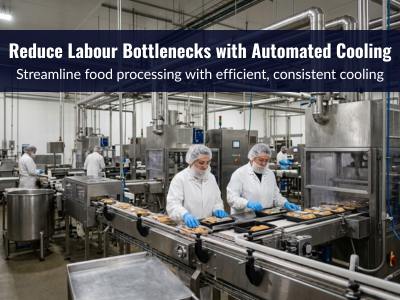
Manual cooling looks simple on paper: make ice, bring it to the product, keep the product cold.
Consider what manual ice handling actually involves during a shift. Someone has to collect ice, move it across the facility, transport it between stations, and fill containers by hand. That same ice often gets handled more than once before it ever reaches the product. Each of these movements is a task that competes directly with production work.
When workers have to be in two places at once
The real cost shows up when workers split their attention between processing and cooling. During busy production periods, a line operator who leaves their station to fetch or move ice is not processing product during that time, and the station they left may sit idle until they return:
- Product waits when ice arrives late, because cooling has to happen within a narrow window after processing.
- Some batches are cooled properly while others sit too long, because manual delivery cannot always keep pace.
- The line’s speed ends up tied to how many people are free to move ice, rather than how fast it can actually run.
Signs Your Cooling Process May Be Creating Labour Bottlenecks
A few patterns tend to show up when cooling is quietly draining labour:
- Workers regularly leave production stations to collect or move ice.
- Cooling delays create waiting between processing stages.
- Extra staff are needed simply to keep ice moving.
- Cooling consistency varies noticeably from batch to batch.
- Production slows whenever ice supply falls behind demand.
The Operational Impact Beyond Labour
Labour is the most visible effect, but manual cooling influences the rest of the operation too.
Inconsistent handling tends to produce inconsistent product temperatures. When cooling depends on manual timing and manual placement, some products are chilled evenly and some are not, which affects both quality and shelf life. Slower, less predictable cooling also means slower throughput, since the line can only move as fast as its slowest dependent step.
The effects rarely stop at the cooling step. When cooling falls behind, downstream processes such as packing, storage and shipping can be pushed off schedule too, since each depends on product arriving cold and on time.
There are secondary effects worth naming:
- Worker fatigue. Repeatedly lifting and moving ice is physically demanding.
- Additional handling and hygiene. Every manual touchpoint is another opportunity for contamination.
- Scaling limits. A manual cooling process that works at current volume often breaks down when volume increases.
None of this means manual methods fail outright. It means they carry hidden operational costs that grow as a plant grows.
How Automated Cooling Systems Improve Workflow
Automation changes the relationship between cooling and labour. Instead of people generating and delivering ice, the cooling system does it continuously in the background.
With automated ice generation, ice is produced on demand and supplied steadily rather than in batches that someone has to fetch. Pipeline distribution then delivers cooling directly to where it is needed, so the product is chilled at the point of processing instead of waiting for ice to arrive. That single change removes a large category of manual tasks: no collecting, no transporting between stations, no repeated handling.
Automation also reduces process variation. Because cooling is delivered the same way every time, the product is chilled consistently rather than according to who happened to be available and how quickly they worked. That makes the cooling process more repeatable and predictable from batch to batch, which is difficult to achieve when timing and placement are done by hand.
The workflow benefits follow naturally. Reduced manual intervention means workers stay on their actual production roles instead of servicing the cooling process. A continuous supply removes the waiting time that manual delivery creates, so the line keeps a steadier pace.
Why Pumpable Slurry Ice Fits This Workflow
This is where our Deepchill® pumpable slurry ice systems fit the operational picture we have described.
Deepchill® produces a pumpable slurry ice made of fine ice crystals suspended in liquid. Because it flows, it can be pumped directly to where cooling is required rather than carried there by hand. That solves the transport and handling problem at its source.
The fine crystal structure also surrounds the product evenly, which supports consistent cooling across a batch rather than the uneven results manual placement tends to produce. In practical terms, our system reduces repeated manual handling, supports a more consistent cooling process, and helps improve workflow efficiency by keeping cooling in step with production instead of lagging behind it. It is not about replacing every worker; it is about removing the unnecessary handling that pulls them away from the work that matters.
Because cooling becomes part of the production workflow rather than a separate manual task, operators spend less time managing ice logistics and more time on production itself.
Manual vs Automated Cooling
| Manual Cooling | Automated Cooling |
|---|---|
| Manual ice handling | Automated ice generation |
| Workers transport ice | Pipeline delivery |
| Inconsistent cooling | Consistent cooling |
| More manual intervention | Reduced manual handling |
| Workflow interruptions | Continuous workflow |
Rethinking the Bottleneck
Solving a labour bottleneck is not only about hiring more people. Often it is about removing the tasks that quietly consume the people you already have, and cooling is one of the more fixable ones. When ice generation and delivery move into the system, the effects add up across the operation: a smoother production flow, better use of the labour on hand, more consistent cooling from batch to batch, and a process that scales with volume instead of buckling under it.
That is the practical case for automated cooling. It lets the line run closer to its real capacity while keeping temperature-sensitive products protected and schedules on track. Our pumpable slurry ice systems are one proven way to get there, backed by more than 45 years of experience, over 2,000 units installed, and used in more than 40 countries worldwide.
If labour and cooling are colliding in your plant, we would be glad to help you find where automated cooling fits. Get in touch with us at (905) 856-0400, and we will work through your production workflow with you.