
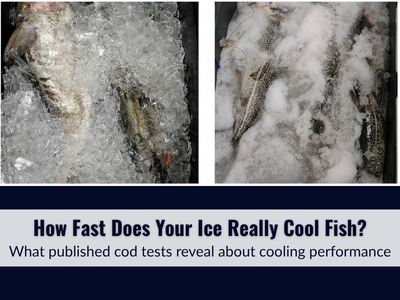
Once fish is harvested, temperature control becomes a priority. Bacterial growth and enzyme activity continue to affect fish quality, and bringing the fish to an appropriate chilled temperature helps slow these processes. How quickly the core temperature drops can therefore influence how well quality is maintained before processing, packing and delivery.
For seafood processors, cooling time is more than a technical measurement. It affects how fish can be staged before filleting, how much flexibility is available in the cold chain, and how consistently product can be handled from one batch to the next.
That is why we believe cooling performance needs to be evaluated under actual operating conditions, rather than by comparing the nominal cooling capacity of different ice types alone. Contact between the cooling medium and the fish, fish size, starting temperature and the ability to maintain a suitable temperature afterwards all matter. Published cod-cooling tests offer a useful way to examine these factors using actual fish.
What the Published Cod-Cooling Tests Show?
The DeepChilling Cod brochure summarises research conducted by Sunwell, the developer of DeepChill technology, in collaboration with the Fisheries and Marine Institute of Memorial University of Newfoundland. The brochure reports two separate cod-cooling tests. Because the tests involved different fish sizes and, in part, different comparison media, their results should be considered separately rather than treated as one experiment.
| Measurement | Test 1: Smaller cod | Test 2: Larger cod |
|---|---|---|
| Fish | Fresh, gutted cod, 1.2–1.4 kg | Cod, 2.0–3.2 kg |
| Initial core temperature | Not specified | 13°C |
| Cooling media | DeepChill slurry ice, flake ice and shell ice | DeepChill slurry ice and flake ice |
| Slurry-ice result | Core reached 0°C in about 60 minutes, then was maintained at approximately −1°C | Core reached 0°C in approximately 1.5 hours, then was maintained at approximately −1°C |
| Comparison result | Flake- and shell-ice samples did not fall below 0°C within three hours | Flake-ice samples reached about 1°C in five hours and about 0.1°C in 9.5 hours, without reaching 0°C |
| Important limitation | Sample numbers, ice-to-fish ratios and other test conditions are not fully specified in the supplied text | Sample numbers, ice-to-fish ratios and ambient conditions are not fully specified in the supplied text |
Source: DeepChilling Cod brochure. These results apply to the specific test conditions described in the brochure and should not be treated as universal cooling-time guarantees.
Reading the Results Carefully
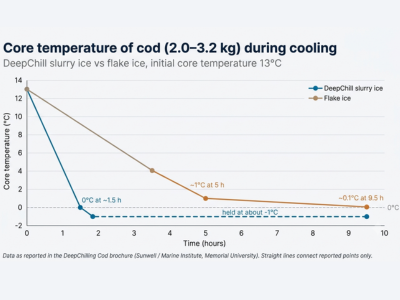
In both reported tests, cod chilled in DeepChill slurry ice reached a core temperature of 0°C considerably sooner than the fish in the flake-ice comparison. The slurry-ice samples were then maintained at approximately −1°C. The flake-ice samples remained above 0°C during the reported test periods.
This difference matters when evaluating the temperature range a cooling system can achieve and maintain. Conventional melting ice typically remains close to 0°C, while a properly controlled slurry-ice system can operate at a lower temperature. Actual performance still depends on the fish, the system design and the conditions in which it operates.
The difference between the two tests also highlights the importance of fish size. The larger cod took approximately 1.5 hours to reach a 0°C core temperature in slurry ice, compared with about 60 minutes for the smaller cod. This is consistent with the greater distance heat must travel from the centre of a larger fish. Starting temperature and probe placement can also influence the results.
These findings provide a useful reference point, but they should be interpreted within their limits. The results are reported for specific test conditions and do not guarantee the same cooling times for every species, fish size or processing setup. In an operating facility, factors such as the fish-to-medium ratio, tank design, circulation and the time between harvest and chilling can all affect performance.
For that reason, we recommend evaluating cooling systems against the requirements and conditions of the operation in which they will be used.
Why Temperature Control Matters Beyond the Initial Cooling Stage?
Bringing fish to a target temperature is only part of the process. That temperature also needs to be maintained during storage, transport and processing. Differences in temperature over time can affect how quickly fish deteriorates, making temperature management throughout the cold chain an important consideration.
The DeepChilling Cod brochure illustrates this point using data from John P. Doyle’s 1989 publication, Seafood Shelf Life as a Function of Temperature (Alaska Sea Grant College Program, University of Alaska). According to the data cited in the brochure, cod held at 4°C spoils approximately twice as fast as cod held at 0°C, and about three times as fast as cod stored at −2°C. These relative rates come from that source and should not be applied directly to other species or storage conditions.
There is also a lower temperature limit to consider. The brochure states that cod begins to freeze at around −2°C and that holding it below approximately −2.2°C can compromise quality. The objective with superchilled cod is therefore to maintain a temperature that slows spoilage without allowing the fish to freeze and lose desirable texture.
This helps explain the relevance of the approximately −1°C holding temperature reported in both cooling tests. It is below the temperature plateau observed in the flake-ice comparison, while remaining above the stated freezing point of cod. However, reaching that temperature during cooling and maintaining it consistently are two separate considerations. Both need to be assessed when evaluating a chilling system.
What Cod-Preservation Research Reveals About Quality and Shelf Life?
The cooling tests discussed above measured temperature changes, not changes in fish quality or shelf life. To understand how superchilled storage may affect the product itself, we also need to consider separate published research cited in the brochure.
One of the studies is Eliasson et al. (2019), The effects of superchilling on shelf-life and quality indicators of whole Atlantic cod and fillets, published in LWT, 100, 426–434. The research compared four handling regimes:
- Superchilled at about −1°C on board and in storage.
- Traditionally iced on board, then superchilled in storage.
- Superchilled on board, then chilled at about 0°C in storage.
- Traditionally iced on board and chilled at about 0°C in storage.
As summarised in the DeepChilling Cod brochure, the two regimes involving superchilled storage (1 and 2) showed a freshness period extended by approximately 2–4 days and a shelf life extended by approximately 2–3 days compared with chilled storage.
The researchers assessed sensory characteristics, including odour, appearance, flavour and texture, alongside microbial and chemical indicators. The brochure also reports that superchilling on board helped slow muscle-protein breakdown and bacterial deterioration.
A second study cited in the brochure, Duun and Rustad (2007), Quality changes during superchilled storage of cod (Gadus morhua) fillets, published in Food Chemistry, 105(3), supports similar findings. Across these studies, superchilling was associated with better sensory scores, lower drip loss, reduced gaping and more favourable microbial and chemical results under the conditions examined.
It is important to distinguish these findings from the cooling tests described earlier. The cited quality studies examined superchilled storage as a temperature regime; the brochure does not state that they used DeepChill equipment. Likewise, the head-to-head cooling tests measured temperature, not shelf life, drip loss or other quality indicators. The connection between the two sets of findings is the approximately −1°C holding temperature, not a single experiment measuring every outcome.
Our article on DeepChilling cod explores the quality and preservation findings in more detail.
What These Findings Could Mean for Seafood Processors?
Taken together, the findings offer a useful starting point for evaluating fish-chilling performance. The reported tests show faster cooling to a 0°C core temperature and subsequent holding near −1°C with slurry ice under the conditions examined. Separate published research associates superchilled storage of cod with longer freshness and shelf life.
What these findings do not establish is the exact commercial benefit a particular processing facility will achieve. That depends on how the cooling system performs within the wider operation.
The evidence and potential implications can be considered in three groups:
- Findings supported by the cited research: The reported tests show a shorter time to a 0°C core temperature with slurry ice than with the comparison ice media. They also report holding near −1°C. Separate studies found longer shelf life and more favourable quality indicators for superchilled cod under the conditions examined.
- Potential operational benefits that need facility-specific evaluation: The brochure suggests that firmer, superchilled fish may be more resilient during processing and easier to fillet and skin precisely, potentially improving yield. It also describes the potential for simpler, faster icing and less labour-intensive ice handling when slurry ice can be pumped and distributed automatically. The extent of any benefit depends on the line design, species, product mix and existing procedures. These outcomes should be measured in the facility rather than assumed.
- Reported customer experience: The brochure includes a testimonial from the general manager of a Norwegian cod fishery and processor. The manager reports that fish cools immediately, shelf life has increased by two days, customer satisfaction has improved and profits have risen. This is an individual operator’s account, not independently verified evidence of financial results across other facilities.
For seafood processors, better temperature control may create more flexibility in shelf-life management and product distribution. If the improvement translates into a longer usable shelf life, it could provide a wider delivery window and help reduce avoidable waste or product downgrading. The actual impact on scheduling, product losses and profitability will depend on handling practices, storage conditions and the distribution process.
The most useful approach is to identify the outcomes that matter to your operation and establish a baseline before making changes. That allows any improvement to be evaluated against actual operating data rather than assumed benefits.
What to Evaluate When Reviewing an Existing Flake Ice System?
If your facility currently uses a flake ice maker or an industrial flake ice machine, the published tests provide a useful starting point for reviewing your existing process. Before deciding whether a different cooling approach is appropriate, measure how your current system performs under normal operating conditions.
Consider the following areas:
- Time to target core temperature: Measure the core temperature of fish in your typical size range and record how long each takes to reach the target. Test larger fish separately rather than assuming the results will be the same.
- Consistency between batches: Compare results across batches, fish sizes and positions within a tote or hold. Fish near the centre of a pile may cool differently from fish closer to the edges.
- Holding temperature: Record temperatures during storage, not just at the end of the initial icing stage. Check whether the product remains just above 0°C or can be held at a lower temperature without freezing.
- Ice handling and distribution: Review how ice is produced, stored, moved and distributed, including how much of the process depends on manual handling.
- Labour and bottlenecks: Identify whether ice handling slows unloading, staging, processing-line feeding or other routine operations.
- Quality and yield: Track relevant measures such as drip loss, gaping, sensory grades, rejections and fillet yield. These records provide a baseline against which any change can be assessed.
System integration and running costs. Consider the space required, pumping and piping arrangements, cleaning, maintenance and energy use across the complete system—not just the ice-making equipment.
These measurements help establish where the existing process is performing well and where there may be room for improvement. They also provide a more meaningful basis for comparing alternative cooling systems.
For a broader overview of the differences between the two approaches, see our comparison of flake ice and slurry ice.
Evaluating Cooling Options for Your Operation
The published cod tests show that slurry ice can cool cod to a 0°C core temperature faster than flake ice under the reported conditions, while maintaining the fish at approximately −1°C afterwards. Separate research links superchilled cod storage with longer shelf life and favourable quality indicators. Together, these findings provide a useful basis for assessing the potential role of slurry ice in seafood processing.
Whether a particular system is suitable for your operation depends on the species and product, vessel or plant layout, production volumes and the outcomes you need to improve. Cooling performance, temperature consistency, handling requirements and running costs all deserve consideration.
At Deepchill, we work with harvesters, seafood processors and aquaculture operators to assess cooling requirements and develop systems suited to their processes. To explore how slurry ice could fit into your workflow, visit our industrial cooling solutions or learn about operators already using the technology.
If you are reviewing your current cooling setup, contact our team to discuss your application, the challenges you want to address and the measurements that can help determine whether a change would be worthwhile.
Sources
- Sunwell Technologies Inc. (2020). DeepChilling Cod (brochure).
- Deepchill. DeepChilling Cod (insights article).
- Doyle, J. P. (1989). Seafood Shelf Life as a Function of Temperature. Alaska Sea Grant College Program, University of Alaska. Cited in the brochure.
- Eliasson, S., et al. (2019). “The effects of superchilling on shelf-life and quality indicators of whole Atlantic cod and fillets.” LWT, 100, 426–434. Cited in the brochure.
- Duun, A. S., and Rustad, T. (2007). “Quality changes during superchilled storage of cod (Gadus morhua) fillets.” Food Chemistry, 105(3). Cited in the brochure.