
If you’re running a seafood processing operation, your ice system isn’t a utility decision — it’s a production decision. The method you use to chill product affects throughput, quality, shelf life, labour hours, and cold chain integrity simultaneously. Most plants default to flake ice because it’s familiar. But familiarity and optimality aren’t the same thing, and in 2026, the gap between the two is costing processors more than they realise.
Here’s an honest operational comparison — what each system does well, where each falls short, and why the difference matters at scale.
How Each System Actually Works?
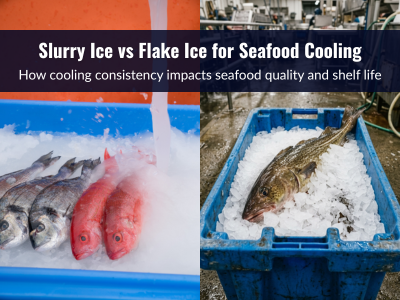
Flake ice delivers thin, flat crystals that stack around the product. It chills by contact, but that contact is inconsistent. Air pockets form between flakes, particularly around irregular product shapes like whole fish, shellfish, or freshly landed catch. Those gaps mean uneven temperature distribution across the load — a real problem when dock-to-processing temperature integrity is critical on high-value species.
Slurry ice delivers billions of pearl-like micro-crystals suspended in a liquid carrier. Because the slurry flows around and between the product, it achieves full surface contact chilling from every angle, including inside fish holds and bulk seafood bins. The result is rapid, uniform heat extraction without the hot pockets that compromise quality and shelf life.
That’s not a marketing distinction. It’s a physics one.
Cooling Speed and Temperature Consistency
Speed matters in seafood processing because every minute above optimal temperature accelerates bacterial growth and quality degradation. Slurry ice achieves significantly faster heat transfer than flake ice — the micro-crystal structure and pumpable slurry medium provide a much higher effective cooling surface area in contact with the product.
For high-throughput lines processing tuna, salmon, shrimp, or white fish, faster pull-down means tighter temperature control at intake and better product condition entering downstream processing stages. For export-oriented operations where fresh catch quality directly determines grading outcomes, that consistency isn’t optional.
Flake ice can maintain reasonable average temperatures but average isn’t the same as consistent. Hot pockets in bulk flake ice bins are a recognised operational problem, often invisible until a QA audit or shelf life failure flags them.
Operational Differences at a Glance
| Flake Ice | Slurry Ice | |
|---|---|---|
| Crystal contact | Uneven; air gaps common around whole fish and shellfish | Full surface contact; slurry flows around product geometry |
| Temperature uniformity | Hot pockets possible in bulk bins | Consistent distribution throughout the load |
| Labour handling | Manual distribution to lines, holds, and packing areas | Pumped directly to point of use; minimal manual handling |
| Hygiene exposure | Multiple open handling points — bins, scoops, transport | Closed-loop delivery; minimal human contact from generation to application |
| Automation | Limited; labour-intensive at high volumes | Automated, adjustable output |
| Production flexibility | Fixed output; less adaptable to demand fluctuations | Crystal concentration and volume adjustable by application |
| Product protection | Sharp crystal edges; bruising risk on delicate species | Smooth micro-crystals; gentler on premium and high-value seafood |
| Scalability | Constrained by manual distribution logistics | Modular systems scale with processing demand |
Both systems chill the product. The operational gap widens at scale, under compliance pressure, and when product value is high enough that quality variance has a direct margin impact.
Where Does It Matters Most in Seafood Operations?
For export-oriented plants, the stakes are higher. Fresh catch quality determines grading outcomes, and grading outcomes determine price. Faster, more consistent chilling at intake from dock to processing line — protects that value before it ever reaches a buyer’s cold store or a QA inspection point.
For compliance teams, the open-system nature of flake ice distribution creates contamination exposure and documentation burden that closed-loop slurry delivery largely eliminates. In seafood QA environments supplying EU, US, or premium Asian buyers, that distinction carries real audit weight. Deepchill’s closed-loop architecture minimises human contact from ice generation to point of application — a meaningful structural advantage when HACCP documentation is under scrutiny.
For operations running multiple shifts at volume, the labour saved on manual ice handling compounds quickly. Slurry is pumped directly to the line — no bins to fill, no manual top-ups, no transport between production areas. Plants running Deepchill systems have substantially reduced ice handling from their floor labour allocation, reallocating that time to higher-value processing tasks.
And for premium seafood preservation particularly delicate flatfish, high-grade shellfish, or export-packed whole fish — the smooth micro-crystal structure of slurry ice reduces bruising and surface damage that flake ice edges can cause. In markets where appearance grading affects final sale price, that’s a tangible yield protection argument.
Making the Evaluation
Flake ice works. For lower-throughput or less temperature-critical applications, it remains a workable option. But for industrial seafood operations where throughput, product quality, hygiene compliance, and cold chain performance are all under simultaneous pressure, slurry ice delivers operational advantages that compound across every shift.
With over 45 years of industrial cooling expertise and systems running across more than 40 countries, our team understands how these decisions play out in real processing environments — not just on paper.
If you’re evaluating your current seafood cooling system, we’re happy to work through the specifics with you. Call us at (905) 856-0400 — we’d rather have a practical conversation than send you a brochure.