
The moment fish leave the water, their thermal environment changes completely. What was once a stable, controlled body of water becomes exposed to air, handling equipment, and warmer surroundings. Temperature that was managed passively now has to be managed actively, and the window to do it well is short. The goal at this stage is not simply to make fish cold. Harvested fish need to be brought toward an appropriate chilled condition quickly and consistently, and that condition has to hold through every step that follows. Get the first cooling step right and the rest of the handling process becomes easier to control. Get it wrong and the difficulty compounds downstream.
Why Temperature Control Becomes Critical After Harvest?
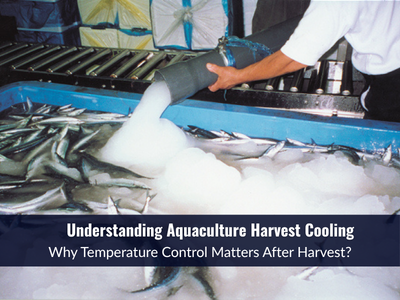
At harvest, fish carry field heat and continue to generate heat through natural biological activity. That heat has to be removed, and removed from the product itself rather than just the space around it. Bringing fish toward a controlled chilled state early sets the baseline for everything after: holding, transport, reception, and processing all depend on the temperature the product arrives with.
Consistency matters as much as the target itself. A harvest load is rarely uniform. Fish sit at different depths, in different densities, and in different positions relative to the cooling medium. If some fish reach the target condition while others lag, the load as a whole is harder to manage later. Effective harvest cooling means controlling the whole load, not just the fish that happen to sit closest to the cooling source.
What Happens When Harvested Fish Are Not Cooled Quickly?
Delayed cooling stretches the time fish spend at higher temperatures and slows how quickly the load stabilizes. Several practical problems tend to follow:
- Greater temperature variation within a single load, making batches inconsistent
- Slower stabilization, so the product takes longer to reach a manageable state
- Less flexibility during holding and transport, since the cold chain starts from a warmer point
- Higher cooling demand later, as downstream steps compensate for heat that was not removed early
- Reduced margin for maintaining product quality when temperature control is inconsistent
None of this means a single delay guarantees a fixed outcome. It means the operation loses control and margin, and control is exactly what a good harvest process is meant to preserve.
Why Uniform Cooling Matters as Much as Cooling Speed
Speed alone can be misleading. A cooling medium can chill rapidly while individual fish lag well behind it. Surface temperature is not the same as the temperature of the fish as a whole, and a cold surface can sit over a warmer core.
Several factors drive this gap. Larger fish take longer to cool through than smaller ones. A densely packed load resists circulation, so the medium reaches some fish easily and others barely at all. Poor contact between the cooling medium and the product leaves pockets that cool slowly. Uneven distribution of the medium creates temperature differences across the load that persist even when the average reading looks good.
The point worth holding onto is this: rapid cooling of the surrounding medium does not mean every fish reaches the target condition at the same rate. A system that cools fast but unevenly still leaves you with an inconsistent load. Real control depends on the medium reaching every fish, not just the average.
What Should an Effective Aquaculture Harvest Cooling System Provide?
A harvest cooling system has to perform under real operating conditions, including peak volumes and continuous handling. The practical criteria that matter most:
- Rapid heat removal that pulls temperature down quickly at the harvest point
- Uniform temperature control across the entire load, not just the surface
- Capacity matched to normal and peak harvest volume
- Reliable performance when demand spikes during harvest windows
- Hygienic operation suited to food-grade handling
- Practical delivery and distribution to the points where cooling actually happens
- Compatibility with holding and transport containers already in use
- Integration with downstream reception and processing
Each of these becomes a limiting factor if it is missing. A system that removes heat quickly but cannot keep up with peak volume, or cannot distribute the medium where it is needed, will not deliver controlled results in practice.
Where Pumpable Slurry Ice Fits Into Aquaculture Harvest Cooling
Slurry ice, sometimes called liquid or pumpable ice, is a cooling medium made of very small ice crystals suspended in liquid. Because it flows, it can be pumped through a distribution system rather than shovelled and spread by hand. The small crystals give extensive surface contact with the fish, and the slurry can surround harvested product instead of relying on point contact from larger solid ice pieces.
That combination addresses the speed and uniformity problem directly. A medium that surrounds fish and reaches into a packed load supports faster, more even heat removal than blocks or flakes sitting on top. Pumpable delivery also supports controlled, repeatable distribution to specific points of use.
Deepchill® produces this kind of slurry using patented technology built around tiny, pearl-like micro-crystals. Our systems generate, store, and distribute the slurry as part of a controlled process, and it can be made with fresh water or seawater depending on the application.
From Harvest to Processing: Where Cooling Fits in the Aquaculture Cold Chain
Harvest cooling is the first link, not the whole chain. A typical flow runs:
Harvest → Initial Cooling → Holding/Transport → Reception → Processing
Temperature control continues past that first step, and the condition fish arrive in at reception depends heavily on how well the initial cooling was handled. Treating harvest cooling as part of a broader temperature-management workflow, rather than an isolated task, is what keeps the whole chain under control.
What Aquaculture Operators Should Consider When Choosing a Cooling System
The right system depends on the specifics of your operation. Useful questions to work through:
- How quickly does heat need to be removed at harvest?
- What are your normal and peak harvest volumes?
- Is your process batch-based or continuous?
- Where does cooling physically take place?
- How will the cooling medium be delivered to that point?
- Can temperature uniformity be maintained across a full load?
- Will the system integrate with existing tanks, totes, and processing equipment?
- What hygiene and operational requirements apply?
Answering these honestly usually points toward the capabilities a system actually needs, rather than the ones that simply sound impressive.
How Deepchill Supports Aquaculture Harvest Cooling?
Deepchill® is designed to cool farmed fish rapidly and uniformly at the harvest point and to hold that control downstream. Our pearl-like micro-crystal slurry surrounds the fish for extensive contact and even heat removal, and it can be generated in seawater or freshwater to suit the operation. The slurry is pumpable, so it can be automatically distributed to points of use, which reduces the manual handling that traditional ice movement demands. Because generation, storage, and distribution run as a controlled, closed-loop process, cooling stays consistent through harvest, reception, holding, transport, and processing preparation.
That capability is backed by experience. With more than 45 years in industrial cooling and over 2,000 units installed across more than 40 countries, we have applied slurry ice to a wide range of aquaculture and seafood operations.
If harvest cooling is a point where your operation loses control, it is worth addressing before it turns into an ongoing constraint on quality and throughput. We would be glad to look at your harvest volumes, handling setup, and downstream processing, and help you plan a cooling approach that keeps the whole chain consistent.
To talk through what would fit your operation, get in touch with our team or call us at (905) 856-0400.