
On a busy processing line, cooling rarely gets much attention until something slows down. Product moves from one stage to the next, temperatures come down, and everything appears to be working. Then production volume climbs, a new SKU is added, or a shift runs longer than planned, and suddenly the cooling stage cannot keep pace. Product starts backing up, downstream stations sit idle, and the whole line feels heavier than it should. That moment is where a cooling bottleneck quietly starts shaping the efficiency of the entire operation.
When Cooling Becomes the Limiting Step?
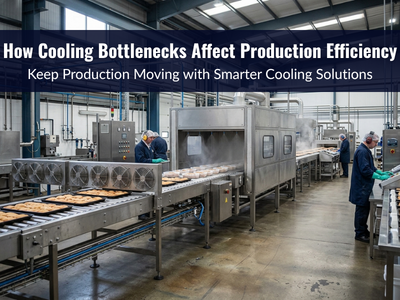
A cooling bottleneck does not mean the cooling system is broken or poorly chosen. A system can perform exactly as designed and still become the slowest point in the process once production demand shifts.
Cooling turns into a bottleneck when its capacity, cooling rate, consistency, or the way product moves in and out of it stops matching the pace of everything around it. If the line can produce faster than product can be cooled and released, cooling sets the ceiling on how much finished product actually leaves the floor. The rest of the equipment may be capable of far more, but it cannot run ahead of the stage holding it back.
How One Slow Stage Spreads Through the Whole Line?
The reason cooling bottlenecks matter so much is that their effect does not stay contained. A delay at the cooling stage does not simply mean cooling takes longer. It means product waits.
When product waits to be cooled or waits to be released after cooling, everything downstream inherits that delay. Packaging waits for product. Labour waits for something to handle. Scheduled runs slip because the previous batch has not cleared. What began as a cooling constraint becomes a production flow problem that touches throughput, timing, and how well the rest of the line can do its job.
This is why throughput is usually the first place the cost shows up. Throughput is not defined by how fast the fastest machine runs; it is limited by the slowest necessary step. When cooling is that step, total output drops even if every other station is technically capable of more.
Waiting Time and Scheduling Pressure
Extended waiting and holding times are one of the clearest symptoms. Product held between stages occupies space, ties up handling resources, and in temperature-sensitive processing can raise real concerns about maintaining required conditions during the wait.
Scheduling feels the strain next. Production plans assume each stage clears within a predictable window. When cooling runs behind, that assumption breaks. Runs get pushed, sequencing has to be reworked mid-shift, and planners lose the reliability they depend on to fit everything into the available time. A cooling stage that cannot be counted on to release product on schedule forces constant adjustment everywhere else.
Underused Equipment and Labour
There is a frustrating contradiction inside a cooling bottleneck: expensive downstream equipment sits underutilised while the operation still struggles to hit its targets. Machines that could be adding value stand idle simply because product has not arrived. Labour has the same problem. Staff either wait for product or get pulled into extra manual handling, moving, staging, and rehandling product that is queuing up around the cooling stage. Neither situation reflects the productivity those people and assets were meant to deliver.
Why Capacity Numbers Do Not Tell the Whole Story?
It is tempting to judge a cooling stage by its nominal capacity alone, but that number rarely predicts whether cooling will actually keep production moving. What matters just as much is how quickly product reaches temperature, how evenly it cools, how consistently the process performs run after run, and how smoothly product transfers in and out.
Uneven cooling can mean part of a batch is ready while the rest is not, forcing the whole load to wait for the slowest portion. Cooling that leans heavily on manual handling introduces variability and delay at exactly the point where consistency matters. And a process that performs well at one production rate can fall behind the moment volume increases. Real cooling performance is about the interaction between cooling rate, product load, heat transfer, and the pace of the line, not a single figure on a spec sheet.
Aligning Cooling With Production Flow
The goal is not simply to cool faster. It is to keep the cooling process capable of supporting the required production flow, consistently, as demand changes.
This is where fast, uniform, and reliable cooling earns its value. Rapid heat removal shortens the time product spends in the cooling stage. Uniform cooling reduces the waiting caused by unevenly chilled loads. Consistent, automated operation removes much of the manual handling and variability that quietly erode flow. Approached this way, automation is not a buzzword; it is what keeps cooling predictable enough for the rest of the line to plan around.
Our Deepchill® slurry ice technology is built around exactly these needs. Because the slurry is pumpable and makes strong contact across the product surface, it delivers fast, uniform cooling that helps product reach temperature quickly and consistently. That consistency is what supports steady production flow and helps reduce the cooling-related delays that ripple downstream. With more than 45 years of experience and installations in over 40 countries, we have seen how much difference dependable cooling makes to an operation’s overall efficiency.
Keep Your Line Moving
If cooling has become the stage that dictates your output, addressing it can free up throughput you already have the equipment and people to deliver. We would welcome the chance to look at where cooling fits in your process and how our slurry ice systems could help keep production flowing. To talk it through, get in touch with our team at (905) 856-0400.