
In industrial baking, dough temperature is often treated as a checkpoint: a probe reading taken at the end of the mix to confirm the batch is in range. In practice, it matters much more than that. Mixing adds heat to every batch, and the temperature the dough reaches at discharge sets the starting conditions for fermentation, makeup, and every stage that follows.
Small deviations at the mixer rarely stay small. They carry forward into proofing schedules, dough handling, and line timing. Controlling dough temperature early helps create more predictable dough behaviour later.
How Mixing Changes Dough Temperature?
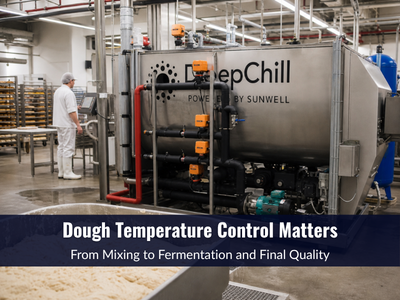
As the dough is sheared, stretched, and folded, much of the mixer’s mechanical energy becomes heat. How much heat is added depends on several variables:
- Mixing intensity and time: Higher speeds and longer development cycles put more energy into the dough.
- Equipment design: Mixer type, bowl geometry, and agitator design all influence friction.
- Ingredient temperature: Flour, pre-ferments, and other inputs each contribute to the batch’s starting temperature.
- Water temperature: This is usually the most adjustable input and the one bakeries rely on most.
- Batch size and formulation: Absorption, dough stiffness, and batch mass affect how heat builds.
Hitting a target dough temperature therefore means working backward. Bakeries estimate the heat the mixer will add and set starting conditions to offset it. That calculation shifts with seasonal flour temperatures, mixing room conditions, and changes to mixing time.
Why Dough Temperature Matters During Fermentation?
Yeast activity is strongly influenced by temperature. Within the ranges used in commercial production, warmer dough generally ferments faster and cooler dough more slowly. The exact response depends on yeast type, sugar and salt levels, and the fermentation method.
For an industrial bakery, the practical issue is predictability. Floor times, intermediate proofs, and final proof schedules are built around expected fermentation rates. Dough that leaves the mixer a few degrees off target can move through those stages at a different pace than the schedule assumes.
Temperature also shapes dough development during fermentation. Gas production and gluten relaxation proceed together, and changes in their rate can alter how the dough behaves at the divider and moulder.
There is no single correct fermentation temperature. A lean dough, an enriched sweet dough, and a retarded process may each call for different targets. What they share is a need for consistency, because uncontrolled temperature variation makes fermentation harder to manage from batch to batch.
What Happens When Dough Gets Too Warm?
Warm dough is not automatically a lost batch, but it can create problems that compound across a shift.
Fermentation may move faster than intended, shortening the processing window between mixing and makeup. On lines fed by several mixers, batches can be ready before downstream equipment is, or later batches can behave differently from earlier ones.
Handling can change too. Warmer dough may become softer or stickier, affecting dividing accuracy, rounding, and moulding. Operators often compensate with adjustments to dusting, proof time, or line speed, which introduces further variability.
Over a production run, these effects can contribute to batch-to-batch variation and make predictable timing harder to maintain. Depending on the product, they may also show up in finished characteristics.
How Dough Temperature Can Affect Final Product Quality?
Final product quality is the cumulative result of the whole process, and dough temperature sits near the start of that chain. Consistent temperature supports more uniform dough consistency at discharge, more predictable fermentation, steadier handling through makeup, and greater uniformity across batches and shifts.
How strongly temperature influences a specific attribute depends on formulation, flour characteristics, fermentation method, and product type. A deviation with little visible effect on one product may be significant on another. The broader principle holds, though. Consistent dough temperature gives fermentation and makeup more predictable starting conditions, and when the rest of the process is also well controlled, that predictability supports more consistent finished-product results. When temperature varies, other process variables have to compensate, and that uniformity becomes harder to maintain.
How Industrial Bakeries Control Dough Temperature?
Most bakeries approach dough temperature control through a combination of ingredient storage control, chilled or adjusted water, mixing speed and time settings, discharge temperature monitoring, mixing room conditions, and dedicated dough cooling where the process requires it.
For many operations, these measures are sufficient. In high-volume production, however, they can reach their limits. Water can only be chilled so far and makes up only part of the dough mass. Intensive mixing, warm ambient conditions, or stiff formulations can generate more heat than chilled water offsets. Mixer cooling jackets remove heat through the bowl wall, so their effectiveness depends on how efficiently that cooling reaches the dough during mixing.
Timing is also a factor. Most of these methods either set the dough’s starting temperature or respond once mixing is complete. A batch that discharges above target usually has to be managed downstream, through adjusted floor times, proof conditions, or schedules. Removing heat during mixing works differently: it offsets friction heat as it is generated, so the dough reaches discharge closer to target and fermentation starts from a more predictable point.
Whether dedicated cooling makes sense depends on the bakery’s products, volumes, and how often temperature targets are missed.
What to Look for in a Dough Cooling System?
For bakeries evaluating dedicated cooling, several capabilities matter operationally:
- Uniform cooling: Cooling should reach the dough evenly, without warm and cold zones in the batch.
- Integration with mixing: Cooling during the mix addresses friction heat as it is generated rather than correcting it afterward.
- Repeatability: Results should be the same regardless of shift or operator.
- Capacity and scalability: The system should keep pace with current throughput and future growth.
- Hygienic design: Food-contact surfaces and cleaning routines must meet bakery sanitation standards.
- Automation: Programmable control reduces manual intervention and the variability that comes with it.
- Process compatibility: It should fit existing formulations and line layouts without forcing a redesign.
Where Deepchill’s Ingrediator Fits Into Dough Temperature Control
For bakeries where chilled water and jacketed mixers cannot consistently offset friction heat, the more direct option is to remove heat from the dough while it is being mixed. That is the role of our Deepchill Ingrediator™, developed specifically for industrial baking.
The Ingrediator combines dough chilling and ingredient mixing in one system. It delivers immediate, uniform cooling while ingredients are mixed, so dough temperature is controlled at the point where friction heat is added. Programmable operation supports controlled, repeatable production across batches.
The system builds on Deepchill’s more than 45 years of experience in industrial cooling solutions, with more than 2,000 units installed in over 40 countries.
The aim is not to replace a bakery’s process knowledge, but to give production teams a more dependable starting point for fermentation and everything downstream.
Talk to Deepchill About Dough Temperature Control
If controlling dough temperature during mixing is a recurring production challenge, Deepchill can help evaluate an approach suited to your bakery’s process and volume. Get in touch with our team at (905) 856-0400 to discuss your dough cooling requirements.