
In food processing environments, ice is not just a utility—it is a critical control point for product quality, safety, and operational efficiency.
Many seafood processors, poultry plants, and produce facilities rely on flake ice makers as a standard solution. However, as production scales and operational demands increase, the limitations of traditional ice systems become more apparent.
What often starts as minor inefficiencies—like uneven cooling or frequent maintenance—can evolve into consistent production bottlenecks.
This is why many facilities are now re-evaluating flake ice systems and transitioning to more advanced cooling technologies like Deepchill® slurry ice systems, which are engineered to deliver precise, consistent, and low-maintenance cooling.
1. Inconsistent Ice Production During Peak Demand
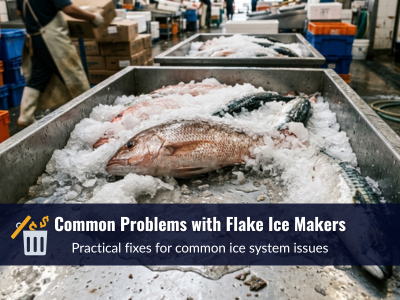
Flake ice makers often struggle to maintain output during peak production periods. Performance drops due to ambient temperature fluctuations, condenser inefficiencies, or scaling inside the system.
Operational impact:
- Delays in product cooling
- Increased manual handling
- Temperature inconsistencies
- Production slowdowns
Why this happens?
Flake ice is produced in batches and depends heavily on mechanical components and environmental conditions.
How Deepchill solves it?
Deepchill systems produce continuous-flow slurry ice, not batch ice.
- Consistent output regardless of peak demand
- Stable cooling performance even in high ambient conditions
- Eliminates dependency on storage buffers
- Immediate availability at point-of-use
2. Ice Bridging and Storage Bin Blockages
Flake ice naturally compacts, melts, and refreezes in storage bins—especially in humid processing environments.
Operational impact:
- Manual labor to break ice
- Production interruptions
- Inconsistent supply to processing lines
Why this happens?
Flake ice relies on bulk storage, which introduces compaction, moisture buildup, and bridging.
How Deepchill solves it?
Deepchill eliminates the need for bulk ice storage.
- No bins → no bridging or compaction
- Pumpable slurry delivered directly to application points
- Reduced labor and zero manual ice handling
3. High Maintenance from Scale and Mechanical Wear
Traditional flake ice makers involve rotating drums, bearings, and freezing surfaces—all prone to wear, scaling, and corrosion.
Operational impact:
- Frequent downtime
- Rising service costs
- Inconsistent ice quality
Why this happens?
Mechanical complexity + water exposure = continuous maintenance cycles.
How Deepchill solves it?
Deepchill systems are designed with lower mechanical complexity and optimized fluid dynamics.
- Reduced scaling and easier cleaning
- Fewer moving parts → lower wear
- Predictable maintenance schedules
- Higher system uptime
4. Uneven Product Cooling on the Line
In food processing cooling, ice only works if it contacts the product effectively. Flake ice often creates uneven coverage—especially with irregular product shapes or conveyor-fed processes.
Operational impact:
- Uneven cooling
- Quality inconsistency
- Reduced shelf life
Why this happens?
Ice falls in clusters, not as a uniform cooling medium.
How Deepchill solves it?
Deepchill produces a fluid ice slurry that fully surrounds the product.
- 100% surface contact cooling
- Rapid and uniform temperature reduction
- Improved product quality and shelf life
- Ideal for seafood, poultry, and produce
5. Messy Ice Handling and Workflow Disruptions
Moving flake ice across a facility introduces unnecessary labor, safety risks, and inefficiencies.
Operational impact:
- Wet floors and slip hazards
- Increased labor costs
- Workflow interruptions
Why this happens?
Flake ice requires manual or semi-manual transport.
How Deepchill solves it?
Deepchill systems use closed-loop delivery systems.
- Automated pumping directly to process points
- No carts, bins, or manual transfer
- Cleaner, safer, and more efficient workflows
6. Sanitation Risks from Open Ice Handling
A flake ice maker may produce clean ice, but open bins, scoops, carts, and transfer points all increase contamination risk.
Operational impact:
- Increased food safety risk
- More stringent sanitation protocols
- Inspection challenges
Why this happens?
Flake ice systems rely on multiple open handling points.
How Deepchill solves it?
Deepchill offers a closed, hygienic cooling system.
- Minimal human contact
- Enclosed transfer from production to application
- Easier compliance with food safety standards
Why Many Facilities Are Transitioning to Deepchill?
At a certain point, operational fixes stop delivering meaningful improvements.
If your team is dealing with:
- Frequent maintenance
- Storage and handling inefficiencies
- Inconsistent cooling
- Labor-heavy workflows
…the limitation is no longer the process—it’s the technology.
Deepchill systems are engineered to replace the entire ice handling paradigm, not just improve one part of it.
Key advantages of Deepchill:
- Continuous, on-demand cooling
- Uniform product temperature control
- Reduced maintenance and downtime
- Eliminated ice storage and handling
- Improved sanitation and compliance
Rethink Industrial Cooling — Not Just Ice Production
Upgrading from a flake ice maker isn’t just about switching equipment—it’s about improving your entire operation.
Deepchill Solutions Inc. helps food processors transition to smarter, more efficient cooling systems designed for modern production environments.
If your current system is creating more friction than value, it’s time to evaluate a better approach.
Call (905) 856-0400 to discuss your operation and explore how Deepchill can optimize your cooling process.