
For commercial and industrial facilities, electricity costs are no longer driven by total energy consumption alone. Peak demand charges—often triggered by short periods of high cooling demand—can account for a substantial portion of a building’s monthly utility bill. Unfortunately, these charges typically occur at the exact moment HVAC systems are under the greatest strain.
HVAC load shifting using thermal energy storage offers a smarter alternative. Instead of generating cooling when electricity is most expensive, facilities can produce and store cooling during off-peak hours—then deploy it during peak periods without sacrificing comfort or performance.
This is where slurry ice technology, pioneered and refined by Deepchill, delivers a decisive advantage through advanced chilling systems designed specifically for load shifting and peak demand reduction.
What Is HVAC Load Shifting?
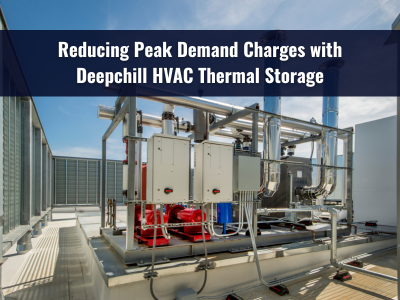
HVAC load shifting is the practice of decoupling cooling production from cooling demand. Rather than operating chillers at maximum capacity during afternoon peak pricing windows, cooling energy is generated overnight—when electricity rates and grid demand are lowest—and stored for later use.
As utilities adopt aggressive time-of-use (TOU) pricing and higher demand penalties, load shifting has become a critical strategy for controlling operating expenses in:
- Commercial buildings
- Data centres
- Industrial facilities
- Institutional campuses
By flattening the electrical demand profile, facilities reduce exposure to volatile peak charges while improving system efficiency.
The Peak Demand Cost Problem
Utilities typically calculate demand charges based on the highest 15- or 30-minute power draw during a billing cycle. A single hot afternoon—when chillers ramp to full output—can lock in elevated demand charges for the entire month.
For large HVAC systems, this means:
- Paying premium rates for short, unavoidable peaks
- Oversized equipment operating inefficiently
- Limited control over monthly energy costs
Load shifting directly targets this problem by limiting peak electrical draw when rates are highest.
How Thermal Storage Enables Load Shifting?
Thermal energy storage systems allow HVAC equipment to operate strategically:
- Off-peak hours: Cooling is produced and stored
- Peak hours: Stored thermal energy meets building demand while chillers idle or operate at reduced load
This approach reduces peak kW demand, stabilizes system operation, and improves overall energy economics.
Why Is Slurry Ice Technology Different?
Traditional ice storage systems rely on large, static ice blocks that limit discharge flexibility and require significant space. Slurry ice technology represents a major evolution.
Deepchill® systems generate a pumpable suspension of microscopic ice crystals in a liquid carrier—creating a highly efficient and controllable thermal storage medium.
Key Advantages of Slurry Ice for HVAC Applications
- High energy density
More cooling capacity per cubic foot, reducing storage footprint - Rapid heat transfer
Instant response to changing cooling loads - Pumpable and flexible
Easily integrates with standard HVAC piping and distribution systems - Precise load matching
Cooling output can be modulated in real time, minimizing waste
These characteristics make slurry ice particularly effective for facilities with variable cooling demand and aggressive peak-load reduction targets.
The Financial Case for Slurry Ice Thermal Storage
Time-of-Use Energy Savings
Electricity rates during overnight hours can be 50–70% lower than afternoon peak pricing. Producing cooling when energy is cheapest delivers immediate cost reductions.
Demand Charge Reduction
By limiting peak electrical demand—often by hundreds of kilowatts—facilities dramatically reduce monthly demand charges. Even partial peak shaving can generate outsized savings.
Improved System Efficiency
Chillers operating during cooler, off-peak hours run more efficiently and experience less mechanical stress, improving performance and extending equipment life.
The Deepchill® Advantage
With over 45 years of experience and installations worldwide, Deepchill® brings proven expertise to HVAC thermal storage projects. Their slurry ice systems are engineered for:
- Long-term reliability
- Consistent thermal performance
- Scalable, application-specific configurations
For engineers and facility managers, this experience translates into lower project risk, faster commissioning, and predictable long-term savings.
Take the Next Step Toward Lower HVAC Costs
Peak demand charges are increasing—not disappearing. Facilities that adopt HVAC load shifting today gain a lasting economic advantage while improving system resilience and sustainability.
Save up to 50% on your annual air-conditioning costs. Contact Deepchill® at (905) 856-0400 to learn how our load-shifting chilling systems can transform your HVAC economics.