
For any operation that depends on consistent, reliable temperature control, the performance of your industrial chiller isn’t a secondary concern — it’s central to product quality, operational efficiency, and bottom-line results.
Whether you’re processing seafood at volume, managing post-harvest produce, running a food manufacturing line, or cooling ingredients in industrial baking, the cooling system you choose shapes almost everything downstream. Yet many facilities are still working with aging equipment or conventional ice systems that simply weren’t designed for the demands of modern production.
Understanding What an Industrial Chiller Actually Does
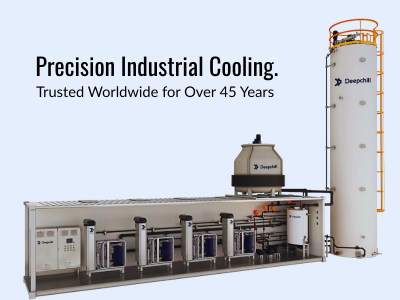
An industrial chiller removes heat from a process, product, or space and transfers it elsewhere — typically through a refrigerant cycle or a liquid cooling medium. In food processing and perishables handling, that means bringing product temperatures down quickly and holding them there throughout the production chain.
The challenge is that “cooling” isn’t one-size-fits-all. A chiller that works well for HVAC applications may be entirely unsuitable for direct product contact. A system designed for a small processing line won’t scale to a high-throughput facility. And a solution that cools efficiently but damages delicate product surfaces isn’t a solution at all.
This is where the design and technology of the chiller system becomes critical.
Where Conventional Cooling Falls Short?
Traditional ice-based cooling — block ice, flake ice, crushed ice — has served industry for decades. But it comes with real limitations that modern operations increasingly can’t afford.
Solid ice forms have limited surface contact. They cool unevenly, sit in gaps rather than conforming to product surfaces, and often require significant manual handling. In high-output facilities, that translates to labour costs, hygiene risks, and inconsistency in cooling rates — all of which affect yield and shelf life.
Mechanical refrigeration systems offer more control, but many are energy-intensive and don’t suit direct product immersion or contact cooling. For seafood processors pulling large catches, or food manufacturers running continuous lines, these gaps matter.
Slurry Ice as an Industrial Cooling Solution
One approach that has gained significant traction across temperature-sensitive industries is slurry ice — a flowable mixture of micro ice crystals suspended in chilled water. It behaves more like a liquid than conventional ice, which means it can be pumped directly to where it’s needed and makes full surface contact with the product it’s cooling.
The practical advantages for industrial cooling applications are meaningful:
- Faster heat extraction: The ice-water mixture absorbs heat rapidly across the entire product surface, not just the points where solid ice makes contact.
- Gentle handling: No sharp edges, no bruising, no physical damage to delicate proteins or produce.
- Pumpable delivery: Slurry ice flows through closed-loop piping systems, reducing manual handling and improving hygiene
- Consistent temperature: The semi-fluid nature allows uniform chilling throughout a batch or tank.
For seafood chilling, slurry ice helps preserve texture, freshness, and shelf life from catch to processing with faster and more uniform cooling. As a produce chiller, it delivers controlled post-harvest cooling without cold burn, dehydration, or surface damage. For food manufacturing and food chiller applications, it supports precise temperature control during mixing, batching, and packaging while keeping production lines running efficiently.
Industries That Benefit from This Type of Process Cooling
Slurry-based industrial chillers are particularly well-suited to:
- Fisheries and aquaculture: Onboard and dockside cooling of fresh catch.
- Seafood processing facilities: Holding and processing lines requiring rapid, consistent chilling.
- Produce and agriculture: Post-harvest cooling for fruits, vegetables, and cut flowers.
- Industrial baking: Dough temperature control during mixing and proofing.
- Food and beverage manufacturing: Ingredient chilling, batching temperature management.
- Cold chain logistics: Transit cooling where flowable ice outperforms block or flake formats.
What to Look for in an Industrial Chiller System?
Choosing the right industrial cooling equipment comes down to more than capacity and price. Facilities should consider:
- Reliability under continuous operation: Industrial environments don’t stop. A cooling system that requires frequent maintenance or has a high failure rate creates costly downtime. Look for systems with proven long-term performance in comparable environments.
- Energy efficiency: Process cooling runs continuously in most operations. Even modest improvements in energy consumption translate into meaningful savings over time.
- System integration: Can the equipment be incorporated into your existing infrastructure? Closed-loop water cooling systems, for example, reduce dependency on external water supply and simplify installation in facilities where water management is a concern.
- Application fit: A system designed specifically for your industry — seafood, produce, bakery, or otherwise — will outperform a general-purpose chiller adapted to the task.
We’ve spent over 45 years developing and refining slurry ice technologyfor industrial cooling applications. Our systems are installed and operating in more than 40 countries, across a wide range of industries and climates. That breadth of deployment has informed how we design for reliability, efficiency, and real-world operational demands.
Choosing the Right Partner Matters as Much as the Equipment
An industrial chiller is a long-term capital investment, and the expertise behind the system — in design, installation, and ongoing support — determines how well it performs over its lifespan.
If you’re evaluating cooling solutions for a new facility, planning an upgrade, or simply trying to understand whether your current setup is still the right fit, we’re happy to have a straightforward conversation about your operation.
Call us at (905) 856-0400 to speak with someone who works in industrial cooling every day. No obligation — just practical guidance.