
Most cooling problems don’t announce themselves. A batch takes twenty minutes longer to reach temperature than it should, packaging waits, the next run pushes back, and by the end of the shift the schedule has quietly slipped. Nothing broke. No alarm sounded. Yet the operation produced less than it could have, using the same labour, the same energy, and the same raw material.
That gap between what a facility processes and what it could process is where the real cost of slow cooling lives. It rarely shows up as a line item. It shows up as delays, idle hands, downgraded product, and capacity that never materialises.
How Slow Cooling Creates Production Bottlenecks?
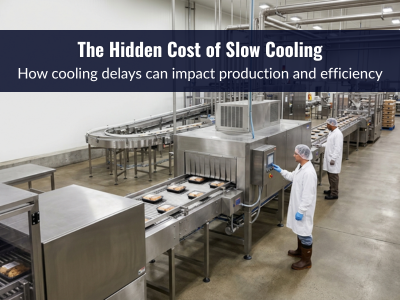
Cooling sits between stages. Product cannot move to packaging, portioning, storage, or distribution until it reaches the required temperature, which makes cooling time a gate rather than a task. When that gate opens slowly, everything behind it queues.
The effect compounds in ways that are easy to underestimate:
- Longer batch cycle times reduce the number of runs a line can complete in a shift.
- Stage-to-stage waiting leaves upstream equipment idle while downstream stations sit empty.
- Scheduling disruption forces production planning around cooling availability rather than demand.
- Peak-period strain turns a manageable delay into a serious constraint when volumes rise.
A cooling system that performs acceptably in isolation can still be the limiting factor in the workflow around it. The question worth asking is not how well the equipment cools, but whether cooling time is setting the pace for everything else.
How Cooling Delays Affect Labour Efficiency?
The labour cost of slow cooling is rarely a headcount problem. It is a utilisation problem.
When batches sit in cooling longer than planned, teams downstream wait, shift handovers get complicated, and staff absorb additional handling and monitoring that adds no value to the product. Accumulated delays push work toward the end of the shift, which is where overtime tends to appear.
The practical result is that a manufacturer gets less productive output from the labour it already employs. Payroll stays flat while output softens, and the connection back to cooling performance is easy to miss.
Spoilage, Downgrading, and the True Cost of Product Loss
Depending on the product, process, and applicable food safety controls, extended time in a temperature range outside the intended profile can increase the risk of deterioration or rejection. This varies significantly by application, and slow cooling does not automatically cause spoilage.
Where it does contribute to loss, the financial impact is heavier than raw material value suggests. By the time the product reaches cooling, it typically carries invested labour, processing time, energy, and often packaging. Losing or downgrading it discards all of that, along with the production slot the batch occupied, which is why the true cost of product loss can be considerably higher than the raw material value alone.
Cooling Performance and Product Quality
Consistent temperature control can support consistency in the finished product. Depending on the application, cooling rate and uniformity may influence texture, appearance, moisture retention, and shelf-life expectations.
Faster cooling is not universally better, and the right profile depends entirely on the product. What matters commercially is repeatability, since consistent cooling conditions from batch to batch can help limit one source of variation in the finished product.
Why Slow Cooling Reduces Production Throughput
Throughput is the metric that ties all of this together. It is simply how much product a facility successfully processes in a given period, and it is where cooling performance becomes a business number rather than a technical one.
Cooling time is part of total cycle time. When cycle time increases, fewer batches complete per shift. Fewer batches mean lower line utilisation, less capacity available for new orders, and reduced ability to respond when demand moves quickly.
This is why throughput deserves attention that cooling equipment specifications alone will not capture. A facility can be fully staffed, fully supplied, and still constrained by how long the product spends waiting to reach temperature. Capacity that is never produced generates no revenue, yet its opportunity cost may never appear as a separate line item in the operation’s financial reports.
The ripple effect: Slow cooling → longer cycle times → production delays → labour inefficiency → lower throughput → greater exposure to product loss and quality variation.
Measuring Cooling as an Operational Metric
Treating cooling as a production variable rather than a background utility starts with a few honest questions:
- How long does each batch actually spend in cooling, measured rather than estimated?
- Is cooling the slowest step in the workflow, or does it only appear so during peak runs?
- How many batches per shift could the line complete if cooling time were shorter?
- Are staff or downstream stations waiting on cooling-dependent steps?
- Do quality holds, downgrades, or losses cluster around delayed batches?
The answers usually reveal whether cooling is a genuine constraint or simply a step in the process. If it consistently shows up as the limiting factor, the next question is whether the current cooling method, equipment capacity, cooling medium, or process configuration still matches the product and the throughput now expected of the line.
Matching the Cooling Approach to the Application
Where that review points to cooling time as the limiting factor, the cooling method itself is often the variable worth revisiting, and the right approach depends heavily on the product, the process, and how the cooling medium contacts what is being cooled.
Slurry ice technology works on that principle. Its pumpable, fine-crystal structure surrounds the product for direct contact and rapid heat transfer, supporting precise temperature control and even cooling across a batch. For suitable applications in seafood, poultry, meat, and produce processing, it can shorten cooling time and support more efficient workflows.
Suitability depends on the product and process, which is exactly what we help manufacturers assess. With over 45 years in food cooling and more than 2,000 systems installed across 40+ countries, we have seen where slurry ice fits well and where it does not.
If cooling is holding your production schedule back, get in touch or call (905) 856-0400. A conversation about your product, volumes, and cycle times can help determine whether a different cooling approach could support better temperature control, throughput, and day-to-day operational performance.