
Shrimp is one of the most temperature-sensitive products in the entire seafood supply chain. The moment shrimp leave the water, natural enzymes and bacteria begin breaking down the delicate flesh, and every degree above target accelerates that decay. Unlike firmer whitefish, shrimp have thin shells and soft tissue that spoil fast, lose firmness, and develop melanosis (black spot) when chilling is delayed. Once spoilage starts, it cannot be reversed. For harvesters and processors, the minutes between catch and cold storage decide whether a batch grades as a premium export product or gets downgraded.
That is why rapid chilling immediately after harvest is not a luxury in shrimp operations. It is the single biggest lever you have over freshness, shelf life, and processing quality. And the ice you choose to pull that heat out determines how well that lever actually works.
How Flake Ice and Slurry Ice Cool Shrimp
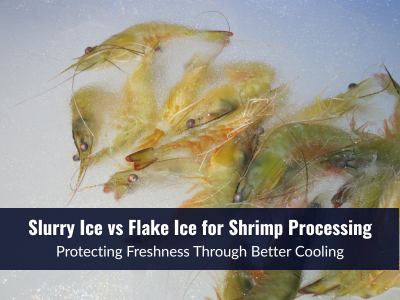
Flake ice cools through direct contact between solid chips and the product. It works, but the contact is uneven. Ice sits where it lands, leaving air gaps around individual shrimp and creating pockets that cool faster than others. Shrimp buried under warmer products chill slowly, and the solid ice has to melt before it pulls real heat out.
Slurry ice behaves differently because it is a fluid. It is a pumpable mix of fine ice crystals suspended in chilled water that flows around and between shrimp, filling the spaces flake ice cannot reach. That full surface contact, combined with the chilled liquid carrier, extracts heat from every angle at once rather than chip by chip.
That is not a marketing distinction. It is a heat-transfer one.
Shrimp Cooling Performance and Temperature Control
This is where the two methods separate most clearly. Shrimp need to reach near-freezing temperatures fast, and the whole batch needs to get there together.
With flake ice, warm spots are common. The shrimp touching ice chill quickly while the rest sit warmer until the ice settles or is reapplied. Part of the batch may already be losing quality before the rest is protected. A comparative study by The Fisheries and Marine Institute of Memorial University of Newfoundland illustrates the gap well: shrimp (Pandalus borealis) cooled in traditional flake ice and water did not reach 0°C even after 18 hours, while shrimp cooled in slurry reached a consistent sub-zero temperature in minutes.
The reason is coverage. A fluid slurry surrounds each individual shrimp rather than cooling only the portions in direct contact with ice, so the entire load drops to target at a similar rate and then holds an even sub-zero temperature across the batch. For shrimp coming off the harvest warm, that difference between cooling a whole batch evenly versus chip by chip is where consistency is won or lost.
Impact on Shrimp Quality and Shelf Life
Faster, more uniform sub-zero chilling protects exactly what buyers pay for.
- Appearance and colour: Rapid cooling helps preserve the natural shell colour and reduce black spot.
- Texture and firmness: When shrimp are suspended in slurry rather than pressed under the weight of solid ice, the product is protected from being squeezed or crushed, holding firmer flesh.
- Bacterial control: Quicker pull-down slows bacterial growth during the critical first hours after harvest.
- Shelf life: Holding shrimp at a steady sub-zero temperature extends usable shelf life through holding, transport, and the steps before processing or freezing.
The result is more head-on shrimp arriving in premium condition and fewer downgrades along the way. This is the principle Deepchill® is built around: cooling shrimp rapidly and uniformly, then maintaining that even temperature through the batch.
Operational Considerations for Shrimp Processors
Cooling performance is only half the story. How a method fits into daily operations matters just as much.
- Labour: Flake ice needs manual layering, topping up, and redistribution. Slurry is pumped and flows on its own, greatly reducing handling.
- Fewer steps: A pumpable system can remove unnecessary steps such as pre-chilling, chemical treatment, and moving ice around the facility.
- Ice consumption: Efficient full-contact cooling means less ice melting and clumping, so operations spend less time and cost replenishing it.
- Throughput: Consistent cooling keeps product moving instead of stopping to re-ice slow batches.
- Hygiene: Slurry moves through a largely closed delivery path, reducing the open scoops, bins, and manual touchpoints that flake handling introduces. For plants supplying EU, US, or premium Asian buyers under HACCP scrutiny, that is a practical advantage.
Flake Ice vs Slurry Ice at a Glance
| Factor | Flake Ice | Slurry Ice |
|---|---|---|
| Cooling speed | Slow, uneven | Faster, full contact |
| Temperature consistency | Warm spots common | Even sub-zero across the batch |
| Product coverage | Gaps around shrimp | Surrounds each individual shrimp |
| Labour | Manual handling | Pumped, minimal handling |
| Quality protection | Crushing and black spot risk | Suspends and protects shrimp |
| Ice consumption | Frequent replenishing | Reduced |
| Scalability | Constrained at volume | Scales with high-volume lines |
Where Slurry Ice Delivers the Greatest Advantage?
Slurry ice earns its strongest value wherever shrimp volumes are high and timing is tight:
- Harvest operations and aquaculture facilities, where large catches need to hit sub-zero fast before quality slips.
- Shrimp receiving areas and processing plants, where incoming product must stay uniformly cold through peak intake.
- Pre-freezing and export-oriented production, where strict grading standards and long cold chains demand consistency on every load.
These are the conditions where the gap between full-contact slurry and solid ice matters most, and where producers serving high-value markets tend to feel the difference in their grading outcomes.
Choosing the Right Shrimp Cooling Solution
Flake ice still has its place. For smaller operations, intermittent use, or less temperature-critical handling, it remains familiar and practical, and we do not pretend it has no role.
But as volumes grow and quality expectations rise, slurry ice becomes the stronger choice. When you need fast, uniform chilling, stable sub-zero temperatures, and reliable batch consistency across a demanding cold chain, full-contact cooling delivers what solid ice cannot.
Protecting Shrimp Quality From Harvest to Export
Better cooling means better shrimp: firmer texture, longer shelf life, cleaner appearance, and a cold chain you can trust. Used in seafood operations worldwide since 1982, Deepchill® rapidly and uniformly cools shrimp, with over 2,000 installations across more than 40 countries.
To see how Deepchill® can strengthen your shrimp cooling and preservation, Call us at (905) 856-0400 or get in touch now.