
Cooling rarely fails all at once. More often it drifts out of step with the plant. Production climbs, product mix shifts, cycle times tighten, and a system that once had comfortable margin starts running flat out just to keep pace. Before committing capital, the important question is not “how much bigger should the new system be?” It is “what is actually limiting cooling performance today, and what will the process demand tomorrow?”
Diagnose the Actual Cooling Problem First
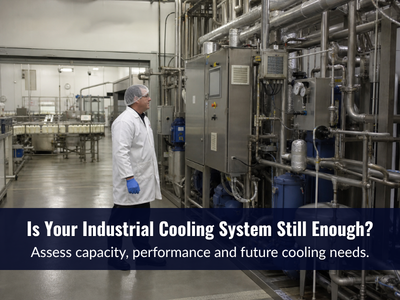
A larger version of the same equipment only makes sense once you know what is constraining you. The symptoms often look similar on the plant floor but point to very different fixes.
- Insufficient capacity means the system genuinely cannot remove enough heat at current load.
- Slow cooling may be a heat-transfer or contact issue, not a capacity shortfall.
- Poor temperature uniformity points to how cooling is applied, not how much is available.
- Rising energy use or maintenance can signal wear, fouling, or a system operating outside its efficient range.
- Excessive manual handling is a process design constraint, not a refrigeration one.
Not every one of these calls for new equipment. Some resolve through maintenance, controls, or process adjustment. Spending on capacity you do not need is one of the more common and avoidable upgrade mistakes.
Evaluate Actual Cooling Demand and Peak Loads
Sizing decisions should reflect what the process requires now, not the nameplate rating of the system you happen to own. Work from real numbers: current throughput, product entering and required final temperatures, target cooling time, and whether you run in batches or continuously.
The distinction that trips up many plants is the gap between average demand and peak load. A system sized to the average will struggle during peak production windows, seasonal spikes, or a heavier product mix, exactly when cooling matters most. Understanding that peak, and how often it occurs, prevents both undersizing and paying for capacity that sits idle most of the year.
Consider Cooling Speed and Temperature Uniformity
Nominal cooling capacity and the actual process outcome are not the same thing. A system can carry an impressive rated load and still fail to bring product to temperature quickly or evenly enough for the process.
Speed and uniformity depend on how effectively heat is drawn out of the product, which comes down to contact, surface area, and the cooling medium itself. Uneven cooling can leave part of a batch out of specification while the rest is fine, forcing conservative cycle times that cap throughput. If consistency is the real constraint, more of the same capacity will not fix it. This is often where a different cooling method deserves a serious look.
Evaluate Energy Efficiency and Total Operating Value
Energy efficiency is not simply “pick a lower-consumption unit.” The meaningful measure is how efficiently the system delivers the required result across real operating hours and loads. A slightly oversized system running below its efficient point can quietly cost more year after year than a right-sized one.
Purchase price is only part of the financial picture. Energy, labour, maintenance, and downtime all shape the true cost of ownership over the equipment’s life. A system that is cheaper to buy but demands more attention and runs less efficiently can prove the more expensive choice. Where efficiency gains are possible, they should be weighed against your specific load profile rather than assumed.
Space, Integration, and Maintenance
These practical realities decide whether an upgrade is even installable.
- Space and layout: Confirm the footprint, product flow, and access for both operation and servicing before selecting equipment. A capable system that disrupts material flow or crowds out maintenance access creates new problems.
- Integration: Because you are upgrading an existing plant, the new system has to work with what is already there, whether that is conveyors, tanks, pumps, piping, controls, or utilities. Evaluating integration early avoids costly surprises during commissioning.
- Maintenance and downtime: Judge a system by what it needs to stay running, not only by how well it cools. Cleaning, accessibility, wear components, and ease of routine service directly affect uptime and long-term cost.
Consider Automation and Labour
If your current cooling process leans on frequent manual intervention, monitoring, or handling, that dependency is worth examining. Well-implemented automation can improve process consistency and free operators from repetitive cooling tasks. It will not eliminate labour or suit every operation, but greater control over the cooling process often translates into more predictable, repeatable results.
Plan for Future Production Growth
Selecting a system around today’s output alone can quietly limit you within a few years. Consider expected growth, new products, added lines, and seasonal demand, then ask whether the upgraded system can absorb reasonable future requirements. The goal is scalability, not oversizing on day one. Solutions that support modular or flexible expansion let you grow capacity as demand materializes rather than paying upfront for volume you may never use.
Plan the Installation and Transition
An upgrade lands in a working plant. Account for required modifications, production interruption, commissioning, and operator training. Where a full changeover would halt production, a phased transition from the existing system may be the more sensible route.
Compare Cooling Technologies, Not Just Equipment Sizes
This is the decision that separates a good upgrade from an expensive one. When a system struggles, the reflex is to install a bigger version of the same thing. Often the better question is whether the cooling method itself still fits the process. Does the application need faster or more uniform cooling? Could a different approach handle it more efficiently, with less labour and more room to scale?
For applications that need rapid, even heat removal, Deepchill® slurry ice technology can be worth evaluating. Our pumpable slurry ice carries fine ice crystals that provide high surface-area contact with the product, supporting rapid heat transfer where the application calls for it. As a closed-loop water cooling system with strong automation potential and scalable configurations, it may suit processes where speed, consistency, or handling are the real constraints. It is not the right answer for every plant, which is precisely why the process, not the equipment size, should drive the decision.
With over 45 years of industrial cooling experience and more than 2,000 units installed across over 40 countries, we have seen where upgrades succeed and where they fall short.
Talk It Through Before You Commit
The costliest upgrades are usually the ones sized around the old system instead of the actual process. If cooling is becoming a constraint, it is worth defining your real demand, peak loads, and growth outlook before spending on capacity you may not need, or discovering too late that you needed a different approach entirely. To pressure-test your requirements and find the right technology fit for your plant, get in touch with our team at (905) 856-0400.