
For commercial aquaculture operations, water temperature is not just one variable among many—it is the primary lever controlling metabolism, growth rates, and immune function. Cold-water species like salmon, trout, and Arctic char operate within narrow thermal bands, and the margin for error is genuinely small. A deviation of even a few degrees during a critical stage can compress feed conversion ratios, trigger stress responses, or in severe cases, can lead to mass mortality.
Choosing the right fish hatchery chiller is not a simple BTU exercise. It requires a working understanding of biological thresholds, facility-specific thermal loads, and the difference between holding temperature steady and pulling it down fast when it counts.
Why Temperature Precision Matters More Than Most Operators Realize?
The challenge with cold-water species is rarely maintaining a static temperature under normal conditions. The real test comes during high-stress events like vaccination, grading, transport, and harvest, when metabolic heat production increases sharply and the system has to compensate quickly.
As water temperature rises, dissolved oxygen levels fall. If your hatchery cooling system cannot keep pace during these events, you enter a feedback loop: warmer water holds less oxygen, fish become stressed, stress increases metabolic heat, and the system falls further behind. Understanding that dynamic is the starting point for any serious evaluation of cooling infrastructure.
Any effective cooling system must handle two distinct load types:
- Holding load: Maintaining ambient tank temperature against environmental heat gain during routine operations.
- Process load: Rapidly chilling water for harvest, live transport, or specific developmental stages where fast temperature reduction is critical.
A system that handles one but struggles with the other usually creates problems in the the production cycle.
Liquid Chillers vs. Slurry Ice: Understanding the Difference
Most hatcheries use conventional liquid chillers, slurry ice systems, or a combination of both. In practice, that difference becomes important pretty quickly.
- Standard liquid chillers circulate water through a heat exchanger to remove heat incrementally. They work well for maintaining steady-state temperatures in raceways or recirculating aquaculture systems (RAS). Where they typically fall short is rapid chilling. Dropping water temperature from 15°C to 2°C quickly demands significant energy, and pushing a standard chiller hard in that scenario risks freezing the heat exchanger.
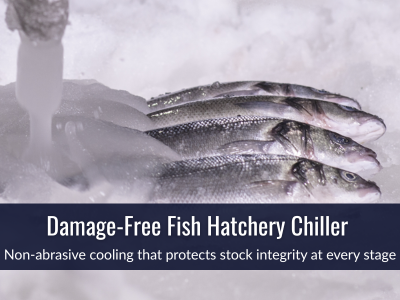
- Slurry ice technology takes a different approach. Instead of chilled water or solid ice which acts as an insulator and creates uneven contact, slurry ice uses microscopic spherical crystals suspended in seawater or brine. The enormous surface area of these crystals allows heat exchange to happen fast and evenly, which is exactly what you need for harvest chilling or transport tanks. The crystals are also non-abrasive, so there is no risk of the scale, gill, or eye damage that sharp flake ice can cause on high-value stock.
For operations where rapid chilling and product integrity are both priorities, slurry ice offers a meaningful thermodynamic advantage over conventional options.
Key Selection Criteria for Hatchery Cooling
When assessing cooling systems for a hatchery environment, these criteria tend to separate adequate solutions from purpose-fit ones:
1. Cooling speed and Delta T: How quickly can the system remove heat under load? For temperature-sensitive species, slow cooling causes stress. A high Delta T in a single pass is the standard you should be benchmarking against—particularly for harvest and transport applications where time matters.
2. Temperature homogeneity: In large tanks, thermal stratification is a real issue. Warm pockets form, fish congregate in them, and dissolved oxygen is depleted faster in those zones. A cooling medium that disperses evenly through the water column (as pumpable slurry ice does) eliminates that uneven distribution and provides consistent thermal protection across the entire tank.
3. Energy efficiency and load shifting: Electricity is one of the largest ongoing costs in aquaculture operations. A well-designed cooling system should offer thermal storage capability — producing ice during off-peak hours when electricity costs are lower and distributing it during peak production periods. That approach reduces the need to run compressors at full capacity during the hottest and most expensive parts of the day.
4. Physical safety for the catch: The cooling medium has to protect the product, not damage it. Jagged flake ice can injure scales, eyes, and gills during harvest or live transport.
Non-abrasive slurry ice crystals preserve product integrity and protect the commercial value of your stock.
The Role of Facility-Specific Engineering
No two hatcheries share the same thermal profile. Source water temperature, ambient air variance, stocking density, and tank geometry all affect how a system needs to be designed and sized. Off-the-shelf HVAC equipment adapted for aquaculture frequently fails in this environment—corrosion, biofouling, and inadequate hygiene standards for food production are recurring issues.
With over 45 years of experience in industrial cooling, we at Deepchill understand how slurry ice production, storage, and distribution need to be engineered for demanding aquaculture environments. A fish hatchery chiller is not peripheral equipment—it is life-support infrastructure for your inventory, and it needs to be built accordingly.
Talk to Us About Your Facility’s Cooling Requirements
Whether you are reviewing your current aquaculture cooling setup, planning an expansion, or dealing with specific thermal challenges, the right starting point is a practical conversation about your species, your facility, and your process loads.
Call us at (905) 856-0400 to discuss your hatchery’s cooling requirements. We work with operations across the industry to design systems that protect stock, reduce energy costs, and hold up under real production demands.